Case study
AI Parenting Coach
Helping parents guide their kids through screen time instead of monitoring them.
An early-stage family-tech startup asked me to get parents to value faster in onboarding. The fastest value wasn't better data. It was one good conversation between a parent and their kid on the first night.
- Company
- Trellis (anonymized), an early-stage family-tech startup
- Role
- Product strategy and product design, with the client's product lead
- Scope
- Product strategy and principles, voice and tone guide, six-screen onboarding, interactive prototype
- Platform
- iOS app
- Team
- Me and the client's product lead
- Research
- Client beta research with founding families, plus public research on parents and screens
- Timeline
- One week
01 Overview
A coach for the parent, not a cop for the kid
The ask Get parents to value faster. But the value came from an AI that needed weeks of data about their kid.
The approach Point onboarding at one good conversation on the first night, before the AI knows anything.
The outcome A product strategy built on four parenting lenses, a voice guide, six-screen onboarding and a working prototype in about a week.
02 The work
Three decisions, prototyped.
Decision 1
A real conversation on night one
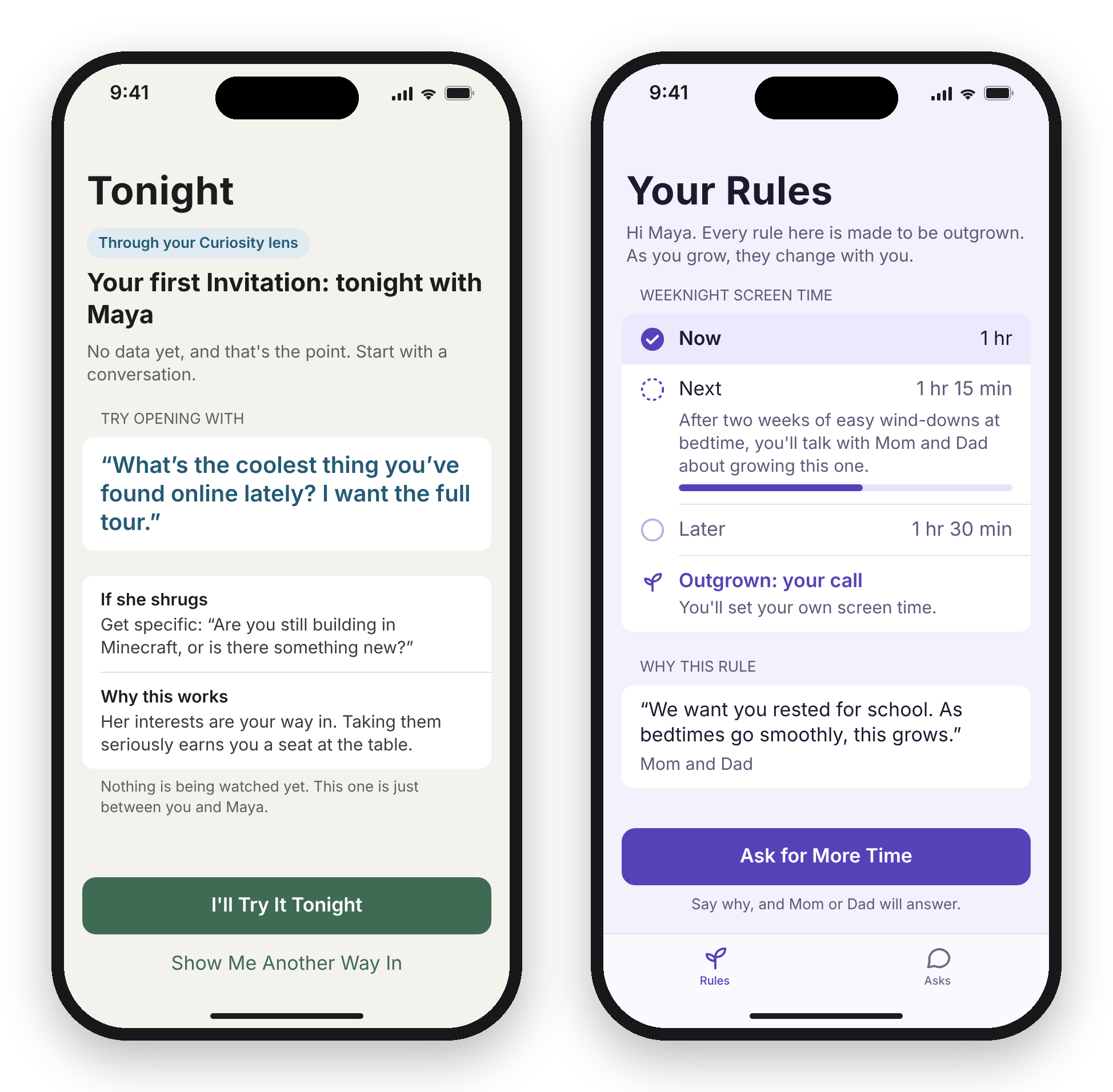
I cut onboarding from eight screens to six and pointed all of them at one moment. Screen five hands the parent a real Invitation for tonight, before the AI has learned anything. Time to value moved from weeks of data collection to the first evening.
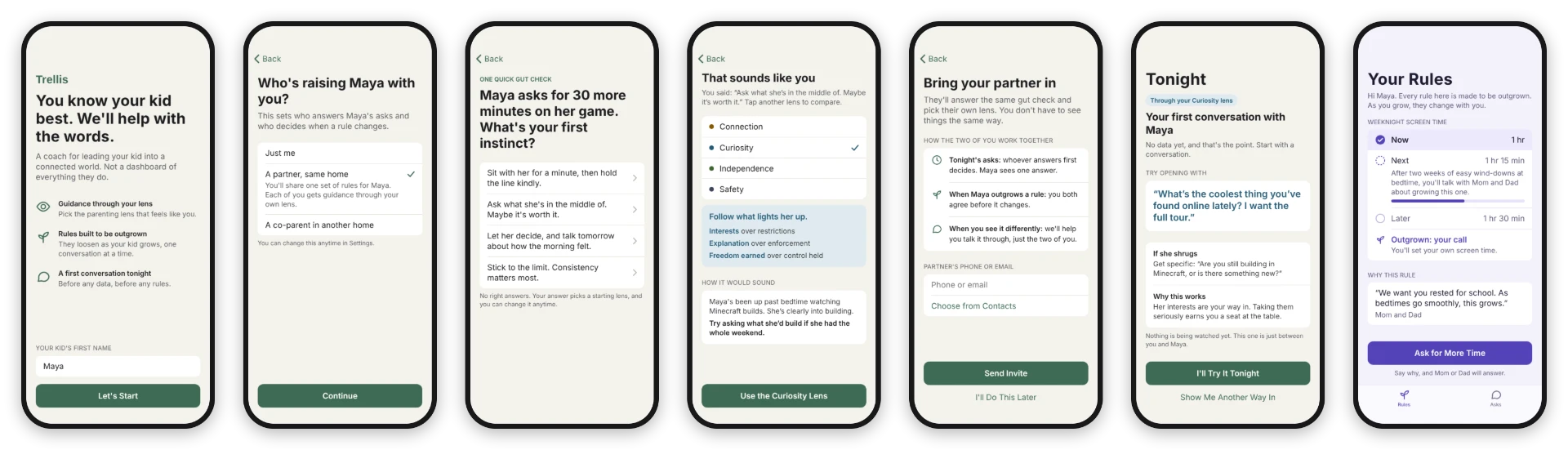
The smaller choices mattered too. We ask "who's raising your kid" instead of asking about marital status. And most parents can't name their parenting philosophy, but they know their gut reaction. So one gut-check question suggests a lens on the same screen. It's a starting point, not a verdict.
“I know what to say tonight.”
Decision 2
The AI adapts to your parenting
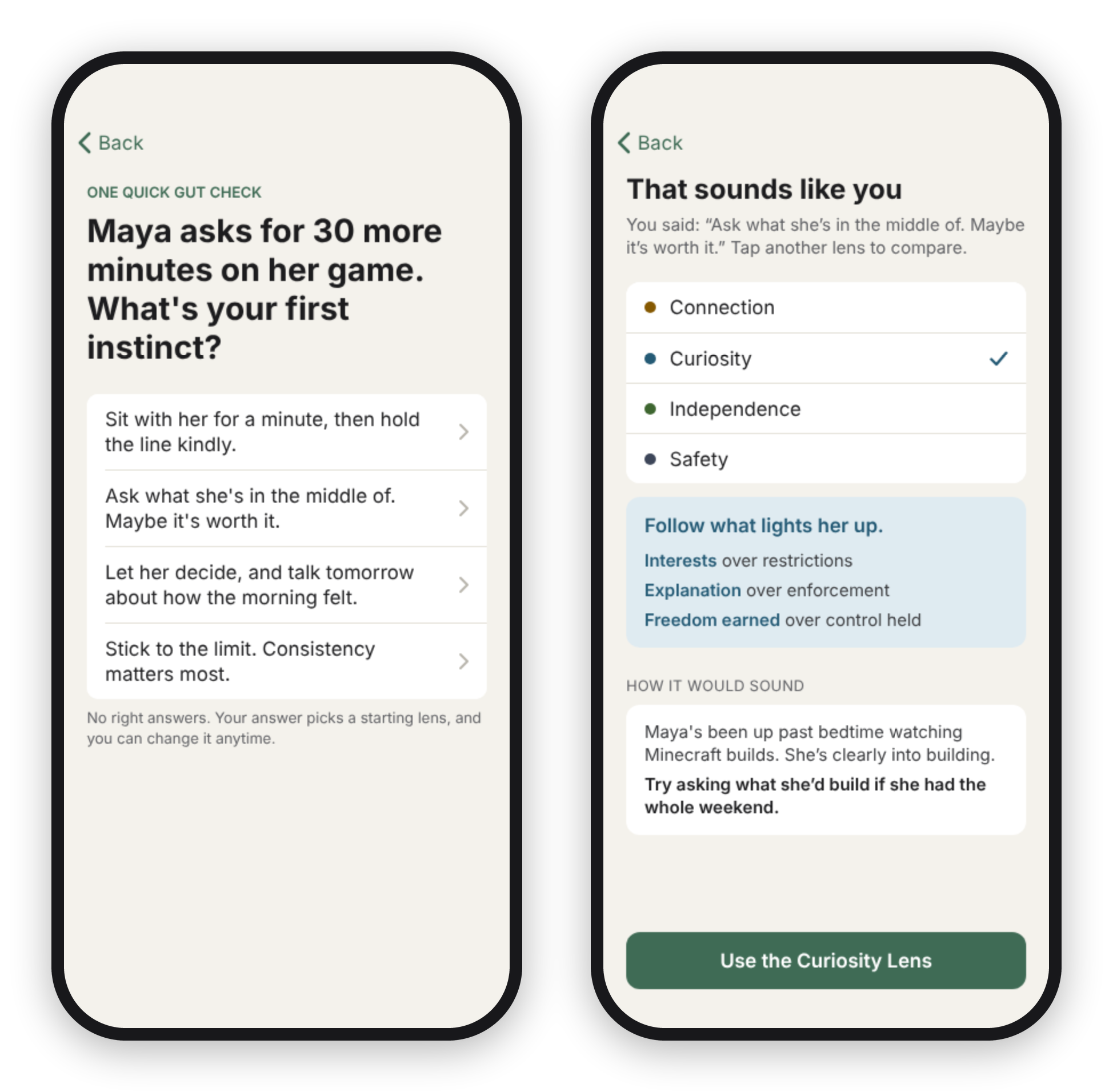
Parents don't share one philosophy, and two-parent homes often don't either. I considered AI personas modeled on named parenting experts and dropped the idea over licensing and likeness. What replaced it was the Lens. A coach tells you what to do. A lens changes what you notice, so the parent stays the decision-maker.
Four lenses (Connection, Curiosity, Independence, Safety) change the emphasis of the guidance but never the structure or the safety floor. Every AI signal arrives as an Invitation in the same four parts. What we noticed, the generous read, your job here, and one next step. Sometimes the job is to do nothing, and the product says so.
In two-parent homes each parent gets their own lens, but the kid sees one set of rules and gets one answer. The first parent to answer a live ask decides. No overrides in front of the kid, and no shopping for a second opinion.
“It sounds like how I already parent.”
Decision 3
Rules built to be outgrown
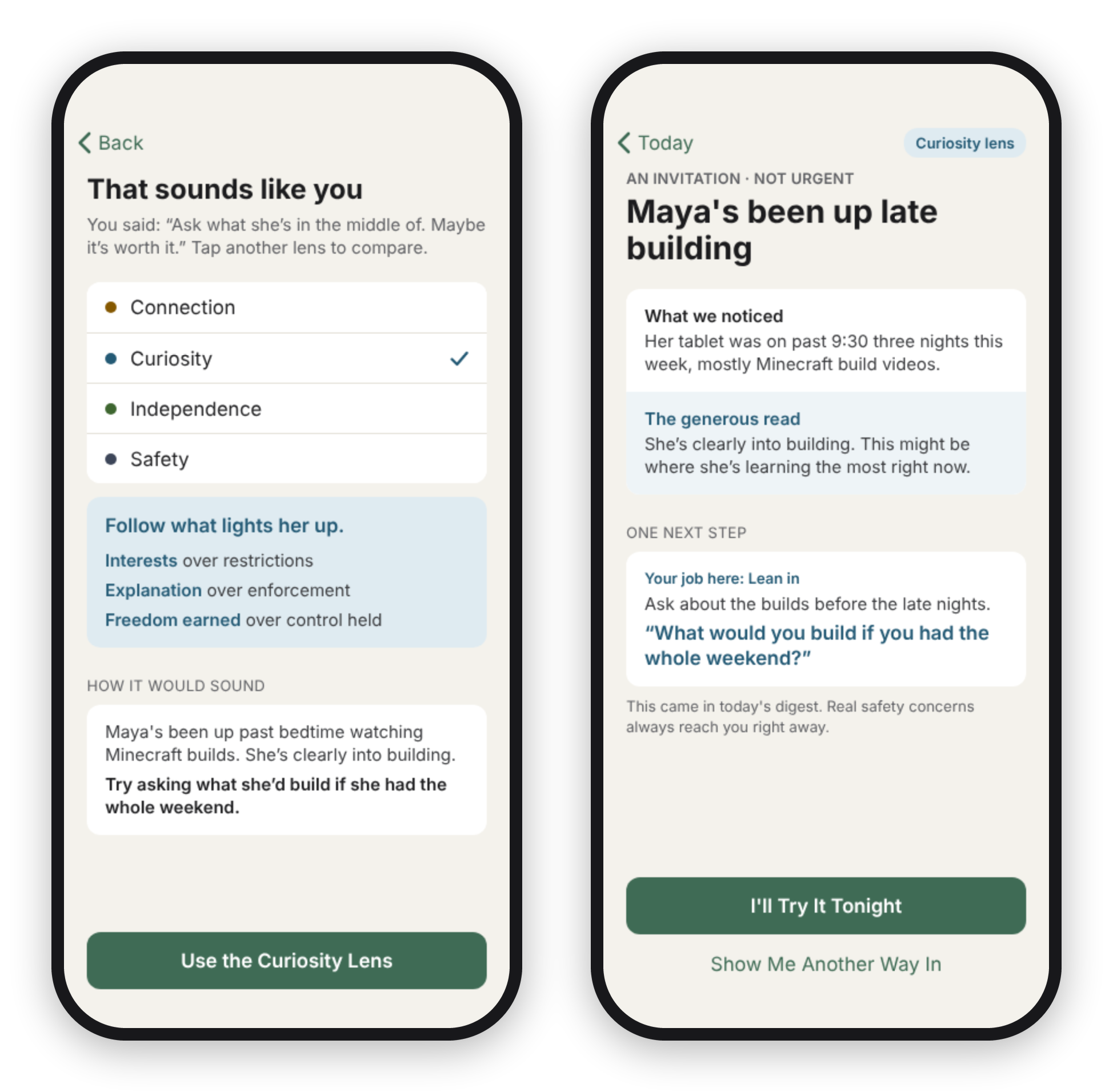
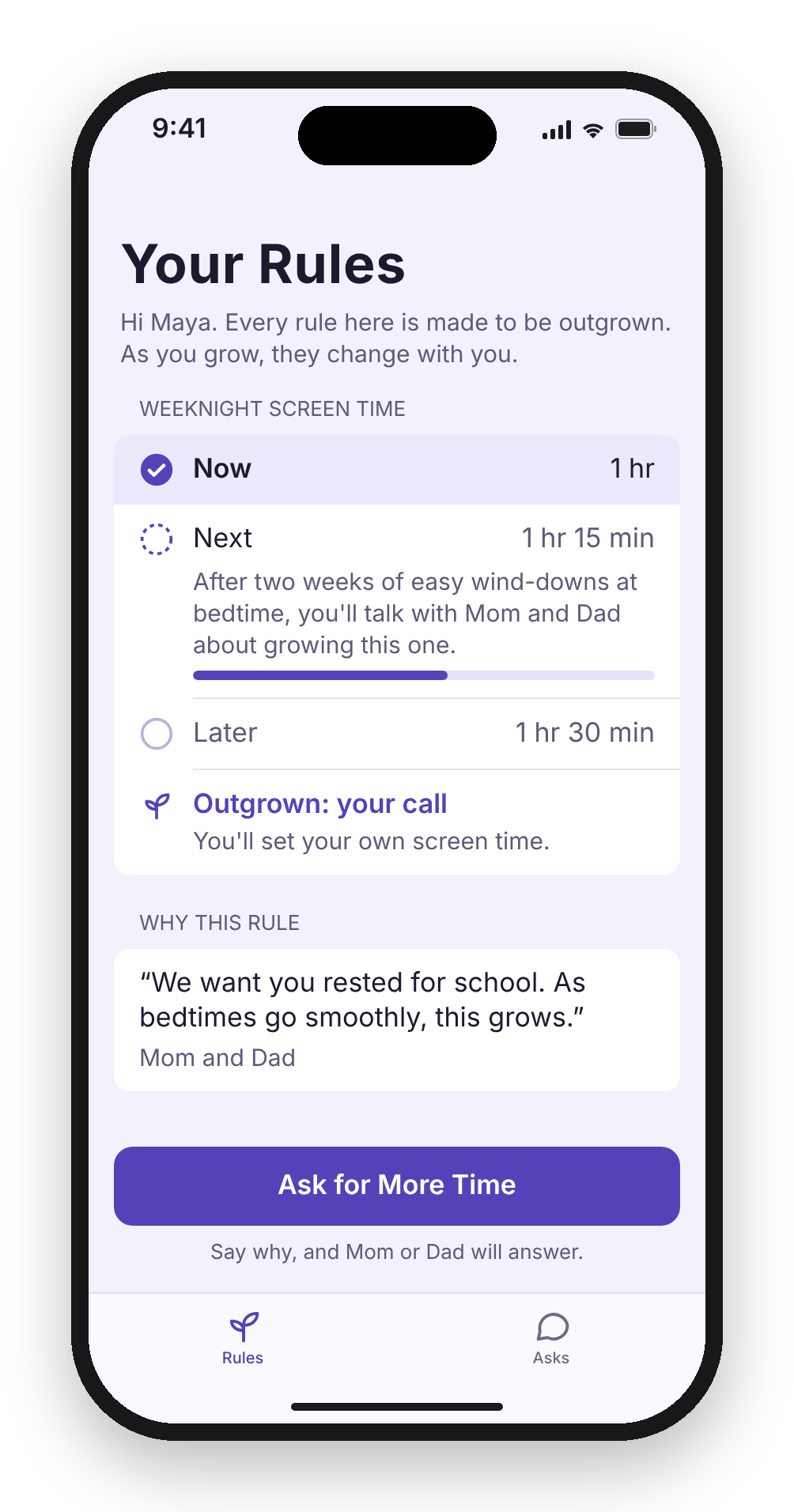
The first version used a ladder. I dropped it because ladders imply earning and a fixed top, and growing up isn't a performance. The ladder became a sprout, and the language became rules built to be outgrown. I kept the word "rules" because it's plain and kids already know it.
Kids see every rule in their parents' words, why it exists, and what comes next. Now, Next, Later, Outgrown. When they want more, they ask. Asks start conversations, and conversations are how a family decides a rule has been outgrown. Nothing is earned or gamified.
The kid's screen got its own warm palette. It's their space, not a window into the parent's dashboard.
“This is fair.”
03 Research
Parents are trying. The tools aren't helping them.
Research like this is why the company started. Parents feel behind, kids are on screens most of their waking day, and the monitoring tools sold to fix it tend to cost trust.
Primary research
Founding families
Before the sprint, the client ran a beta with a few hundred early users they called founding families.
What it showed
Value came too late
That first-hand research is where the ask came from. Parents needed to see value sooner than the product could deliver it.
- of parents of kids 12 and under say they could be doing better at managing screen time. Pew Research Center, 2025
- 42%
- a day of entertainment screen time for a typical teen. Tweens average about five. Common Sense Media, 2026
- 8 hrs
- of kids’ reviews of parental-control apps gave two stars or fewer. Many said they’d rather their parents just talk to them. CHI 2018
- 79%
Monitoring is not involvement In a survey of 215 parent and teen pairs, parental-control app use was linked to teens facing more online risk, not less. Parents being involved and present was linked to less victimization. Ghosh, Wisniewski et al., CHI 2018
Pediatricians moved too The AAP's 2026 policy says limiting screen time probably isn't enough. Its family media plan asks parents to look at what kids do online, and to keep an ongoing conversation going. Pediatrics, 2026
Stats are from public sources. The founding families research stays with the client.
04 Clarity
Parents felt they were losing their place as their kid's guide.
What we were asked
Design onboarding that gets parents to value faster.
The founding families showed that value arrived too late. It came from an AI agent learning a kid's patterns, and that takes weeks. So a new parent's first experience was setup, and then waiting.
What was really going on
Parents were losing their place as their kid's guide.
The brand promised connection over control, but the product was built on monitoring, crypto rewards and alarm-style marketing. Speed was a symptom of that gap.
Parents show up frustrated, a little afraid of what's behind the screen, and feeling their influence fade right when it matters most. Only one of those is about information.
What it meant for the design
Three findings, three decisions.
- Parents don’t lack data. Many feel behind and unsure what to say. over 1. give them the words for tonight, before the ai has learned anything.
- Families don’t parent the same way, and a single rulebook doesn’t fit. over 2. four lenses change what the guidance notices, with one shared safety floor.
- Control without explanation costs trust, and kids notice. over 3. kids see every rule, why it exists, and how it gets outgrown.
| Finding | Decision |
|---|---|
| Parents don’t lack data. Many feel behind and unsure what to say. | 1. Give them the words for tonight, before the AI has learned anything. |
| Families don’t parent the same way, and a single rulebook doesn’t fit. | 2. Four lenses change what the guidance notices, with one shared safety floor. |
| Control without explanation costs trust, and kids notice. | 3. Kids see every rule, why it exists, and how it gets outgrown. |
“If value depends on data, it will always be slow. A good conversation can happen on day one.”
We gave up the see-everything pitch that monitoring products compete on. That was a trade, not an oversight.
05 Outcome
What I handed over, and how we'd know it worked.
In about a week the client had a product strategy and principles to hold it to, a character and voice guide, a six-screen onboarding flow, and a clickable prototype where the kid's view and the parent's view actually talk to each other. More than any screen, they had a different answer to their own question. Value on the first night, not the third week.
This was a sprint, not a launch. So these are the signals I'd watch, not results I can claim.
It's working if
- Parents report a real conversation in week one
- Kids ask for more time instead of finding workarounds
- Parents act on Invitations, not just read them
- Rules actually get outgrown over months
We're wrong if
- Parents skip the conversation and go straight to alerts
- Retention tracks alert volume
- The real job turns out to be monitoring, and we projected our values onto it
06 Reflection
What's still open.
Principles are only useful if you hold the product to them, including the parts that make money. So I didn't hide the tensions. I named them.
The crypto rewards were the big one. Paying kids for good behavior can turn reasons into incentives, which is the opposite of explanation over enforcement. Could rewards become recognition a family defines together? The alarm-style marketing was another. Fear probably converts. But it contradicts the calm the product promises the moment a parent opens it.
And then the question I still don't have a clean answer to. If success means a kid needs fewer rules over time, what does the business model reward? A product built to be outgrown is a strange thing to sell. I think it's the right thing to build anyway. But that's a conversation for the founders, not a screen.
- Should kids see, at least in summary, what the AI notices about them?
- Would a calm daily digest beat real-time alerts, even if engagement drops?
- Lens or Coach? A cheap copy test. The structure underneath doesn't change.
How I worked
Clarity found the problem under the ask. Character set the convictions every screen answers to. Craft turned them into one system. This is the 3 C's on a real product under a one-week clock.
What’s next
More coming soon
Craft is next. The product principles, the voice, and where we put our care.
Trellis is a placeholder name. The client is anonymized.